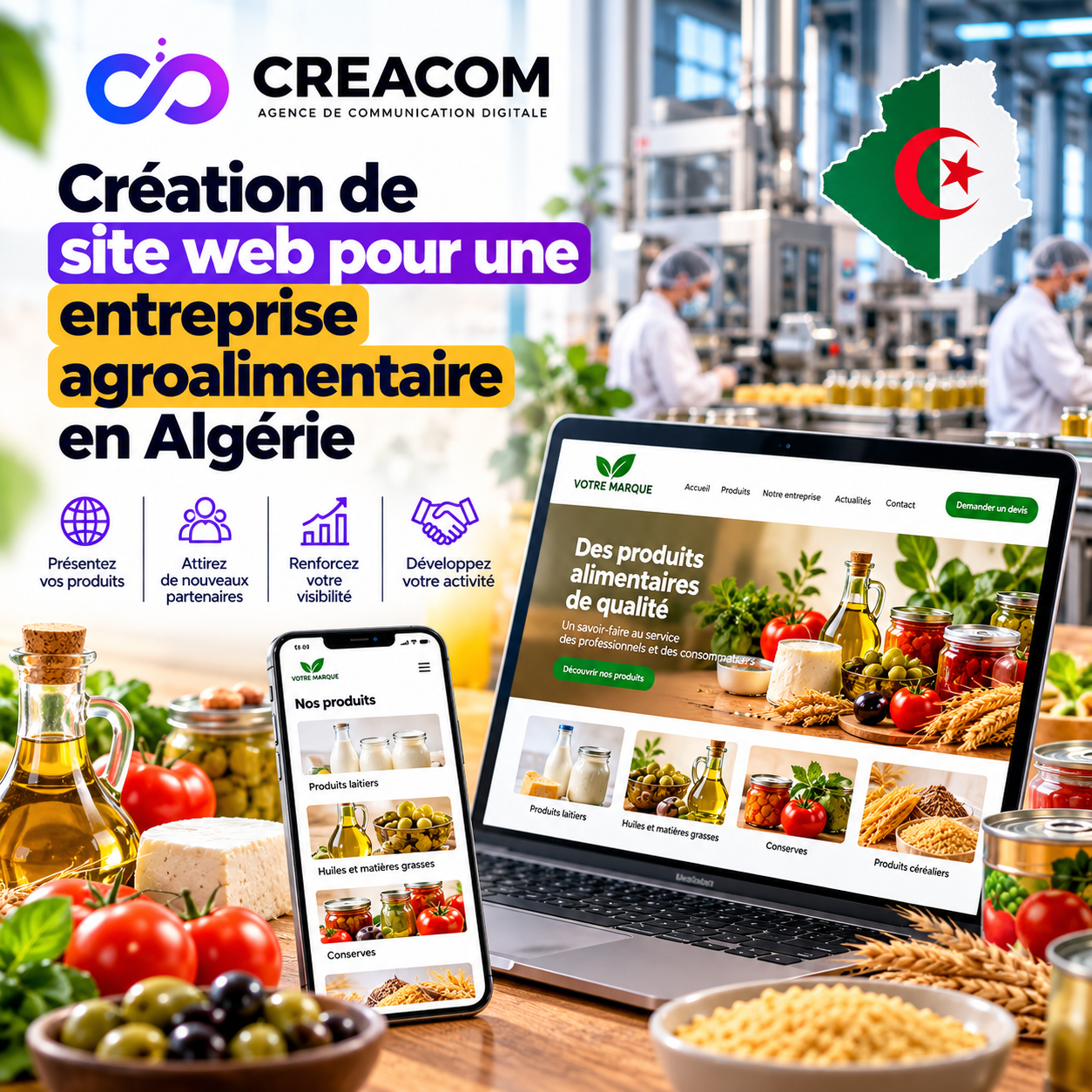
Website Development for a Food Industry Company in Algeria is an important way to increase visibility, showcase products, and strengthen credibility with customers and business partners. In a sector where quality, trust, and product presentation play an essential role, a professional website helps communicate your business activities more effectively and makes it easier for potential customers to contact you.
Whether you are a manufacturer, producer, distributor, importer, or owner of a food brand, your website can become a genuine digital showcase. It allows you to introduce your company, highlight your product range, and meet the expectations of wholesalers, retailers, food service professionals, and consumers.
In this article, CREACOM explains how to plan a website that meets the needs of food industry companies in Algeria.
Why Create a Website for a Food Industry Company in Algeria?
Social media makes it possible to communicate quickly with an audience, but a website provides a professional space that your company can organize according to its own objectives. It centralizes important information and allows visitors to discover your business without relying exclusively on social media platforms.
Developing a website for a food industry company can help you:
- Introduce your company, its history, and its expertise.
- Showcase your products and their characteristics.
- Present available sizes, packaging, and applications.
- Make information and quotation requests easier.
- Build relationships with distributors and business partners.
- Improve your visibility on search engines.
- Strengthen your professional image with potential customers.
A well-designed website does not automatically guarantee new sales, but it provides a solid foundation for presenting your offer, reassuring visitors, and facilitating business communication.
1. Define the Objectives of Your Food Industry Website
Before starting website development, it is essential to determine what you want to achieve. The needs of a food processing factory selling to wholesalers differ from those of a brand selling its products directly to consumers.
Your website can serve several purposes:
- Present your company and its production capabilities.
- Provide an online product catalogue.
- Attract distributors, wholesalers, and retailers.
- Receive price requests and partnership inquiries.
- Sell products online when this fits your business model.
Defining these objectives from the beginning helps you choose the right structure, features, and content without adding elements that do not meet your business needs.
2. Present Your Products Professionally
The product catalogue is often one of the most important sections of a food industry website. Visitors should be able to quickly understand what you offer and identify the products that meet their needs.
Create a Dedicated Page for Each Product
Each product page can include the product name, photograph, clear description, available sizes, packaging, and main uses. Depending on your business, you can also add technical documents or information intended for professional buyers.
Pay Attention to Product Photography and Packaging
High-quality images help create a professional brand image. Packaging should be clearly visible, photographs should be sharp enough, and visuals should be consistent with the company’s visual identity.
Organize Your Catalogue into Categories
If your company offers several product ranges, organize them into easy-to-understand categories. This structure helps visitors quickly find the products they are looking for and makes website navigation easier.
3. Build Trust Through a Professional Presentation
A professional website should provide clear, consistent, and up-to-date information. Potential buyers and partners want to understand who you are, what you sell, and how to contact you.
Include a company profile page explaining your business, experience, product ranges, and market positioning. If relevant and verifiable, you can also present your production capabilities, equipment, certifications, and quality commitments.
Only display certifications, guarantees, or technical information that your company can genuinely substantiate. In the food industry, accurate information helps maintain visitors’ trust.
4. Make Your Website Mobile-Friendly
Many visitors access websites using smartphones. Your website must therefore adapt to different screen sizes so that text, images, menus, and forms remain easy to use.
When developing your food industry website in Algeria, make sure that:
- Pages display correctly on smartphones, tablets, and computers.
- Product photographs remain clear and easy to view.
- Buttons and links are easy to tap or select.
- Contact forms are simple to complete.
- Pages load within a reasonable time.
A well-designed mobile experience makes it easier to browse your catalogue and contact your company.
5. Add Features That Match Your Business
Not all food industry companies need the same website features. Your choices should depend on your customers, sales organization, and how you want to present or sell your products.
An Information Request Form
A contact form allows visitors to ask questions, request information, or arrange a business meeting. It can include the company name, contact details, type of inquiry, and a message field.
A Catalogue for Professional Buyers
For manufacturers and distributors, an online catalogue makes it possible to present product ranges, sizes, and packaging. If prices are reserved for professionals, you can use a quotation request system instead of displaying prices publicly.
Documents to View or Download
Depending on your customers’ needs, you can provide PDF catalogues, product sheets, or technical documents approved by your company.
An Online Store When Needed
If your strategy involves selling directly online, an e-commerce store can include a product catalogue with prices, a shopping cart, an ordering process, and payment and delivery options suited to your market. B2B businesses may require specific commercial features.
6. Optimize Your Website for Google Search
Website development for a food industry company in Algeria should include search engine optimization from the design stage. SEO helps search engines understand page content and can improve visibility for relevant searches.
Choose the Right Keywords
Identify the search terms your customers may use to find your products or services. Depending on your business, these may include a product name, food category, packaging type, or industry-related search associated with Algeria.
Optimize Titles and Descriptions
Every important page should have a descriptive title and useful content. Product pages should clearly explain the features of each offer, while company profile pages should accurately describe the business.
Optimize Images
Use descriptive file names, add alternative text where relevant, and compress images to reduce their file size. These practices improve accessibility and contribute to better technical performance.
Create a Consistent Internal Linking Structure
Link related pages together, such as product categories, product pages, and contact pages. You can also consult Google’s official SEO Starter Guide.
SEO takes time and requires ongoing work. A technically sound website alone does not guarantee a first-page Google ranking. Results depend on competition, content relevance, and many other factors.
7. Make It Easier for Customers and Distributors to Contact You
For a food industry company working with professionals, the website should make business inquiries easier. Visitors should quickly find the information they need to request a quotation, obtain a catalogue, or discuss a partnership.
Make sure to clearly display:
- The company name and professional contact details.
- The address and operating area, where relevant.
- A professional email address.
- A telephone number or suitable contact method.
- A form for information and quotation requests.
You can also connect your website to your social media accounts to give visitors several ways to discover your company. Explore our community management service to strengthen consistency between your website and digital communication.
Which Type of Website Should a Food Industry Company Choose?
The right website depends on your business model and objectives. Here are the main options to consider.
A Business Website
A business website presents the company, its expertise, services, or product ranges. It is suitable for companies that want to strengthen their professional image and make it easier for visitors to get in touch.
A Product Catalogue Website
A catalogue website presents several products in organized categories. It is particularly suitable for manufacturers, distributors, and suppliers who want buyers to browse their range without necessarily displaying prices or offering online purchases.
An E-commerce Website
An e-commerce website allows you to sell products online. It requires an appropriate system for managing orders, stock, payments, delivery, and customer service.
The best choice is the one that matches your company’s commercial objectives, resources, and customer expectations.
Why Choose CREACOM for Your Food Industry Website Development?
Developing a professional website requires careful planning of page structure, product presentation, user experience, and search engine optimization. For a food industry company, these elements must be designed around its catalogue, market, and customers.
CREACOM supports businesses in designing websites tailored to their needs, with a focus on product presentation, navigation, mobile display, and SEO fundamentals.
Depending on your project, we can help structure company pages, organize a product catalogue, integrate contact forms, and prepare a technical foundation that supports search engine optimization.
Discover our website development service and let’s discuss your food industry company’s needs.
FAQ: Website Development for a Food Industry Company in Algeria
Why Does a Food Industry Company Need a Website?
A website allows you to present your company, showcase your products, centralize important information, and make it easier for customers, distributors, and business partners to contact you.
Which Type of Website Should a Food Manufacturer Choose?
A business website or product catalogue website is often suitable for manufacturers who want to present their company and product ranges. An e-commerce store is more appropriate when direct online sales are part of the commercial strategy.
Can You Display a Product Catalogue Without Showing Prices?
Yes. A catalogue website can present products, their features, and packaging while inviting visitors to request a quotation or contact the sales department.
Is SEO Included in Website Development?
Website development can include SEO fundamentals, such as a clear structure, descriptive titles, pages optimized for relevant keywords, and image optimization. A more comprehensive SEO strategy may require separate support and ongoing monitoring.
Is Having a Website Enough to Rank First on Google?
No. Website development is only the first step. Rankings also depend on content quality, competition, page relevance, website authority, and technical factors.
Launch Your Food Industry Website Project with CREACOM
Website Development for a Food Industry Company in Algeria helps build a professional digital presence, present products in an organized way, and facilitate relationships with customers and business partners.
By defining your objectives, choosing the right features, and working on SEO from the design stage, you can create a digital tool that supports your commercial strategy.
Would you like to present your food industry company online? Contact CREACOM to discuss your project and identify the solution that best suits your business.
Website: https://creacom-dz.com/ Email: contact@creacom-dz.com

Written by
creabuzz
Related Posts
- creabuzz
- November 1, 2026
Social Media Management for Clinics in Algeria
Social Media Management for Clinics in Algeria has become an important part of healthcare commu ..
- creabuzz
- November 1, 2026
Medical Website Development in Algeria
The development of medical websites in Algeria enables clinics, medical practices, imaging cent ..